For this month’s Session, Alistair Reece at Fuggled has chosen a topic he calls Sepia Tones, basically a look back at what makes your Beer Story.
Without further ado, here’s mine, albeit a bit late. (And by the way, Mr. Reece, many thanks for jumping in to host at the last minute.)
My Beer Story started as a child in the San Francisco Bay Area. Dad would tell me to get him a beer (usually Olympia) out of the fridge. At some point, maybe age 10 or so, he’d let me open it and take a sip (or two) as I brought it to him.
Olympia played a big part of my childhood. Mom grew up in the Pacific Northwest, and every other summer we’d pile in the car for the long drive north to visit relatives. Without fail, Mom would snap a photo (or several) of Olympia’s Tumwater brewery, visible from the freeway as we passed.
In fact, Oly literally followed me into college. The truck Dad passed down to me had a camper shell, the entire back window of which proudly displayed the Olympia logo, complete with “It’s The Water”.
I’m saddened for what’s happened to the brand, especially since the facility, framed by so many car windows in so many of Mom’s photo albums, closed years ago. Pabst brews it in Los Angeles now, a fact underscored by a recent lawsuit claiming “It’s the Water” is false advertising, since it’s no longer been the water for quite some time. I doubt it’ll go anywhere, but I gotta admit it did make me smile.
THE COLLEGE YEARS
The late ’80s/early ’90s in Sacramento were filled with whatever mass-produced dreck I could afford — Hamm’s, MeisterBrau, Milwaukee’s Best, Schaefer, Burgie, you name it. I could always tell when my dorm roommate’s check arrived from his parents — the fridge would suddenly be stocked with Heineken.
Lucky Lager was a favorite during the dorm days. We spent many an afternoon sitting in a circle on the floor as we downed one after another, passing around the bottle caps to see if we could solve the picture puzzles underneath. Which undoubtedly got harder as the day got longer.
A later roommate worked for a local chain drug-store. One day he came home with several cases, remainders of broken six-packs, that they sold to employees for a Quarter each.
You’d have thought we won the lottery.
What really got me into “microbrews”, even more than Sierra Nevada, was Samuel Adams. Boston Lager was a revelation. Actual color! And flavor! Yes, it cost a few extra bucks, but by that time I had a decent-paying college job (with weekends off!), so I could splurge on the occasional six-pack.
If Boston Lager started my education, Rubicon Brewing accelerated it. As a newly minted 21-year-old in 1989, it was probably the first brewery I ever visited. I marveled at all the styles on the chalkboard. Amber Ale? Porter? ESB? What WERE these things?
Another favorite of my Sac State days was the long-since-defunct Hogshead Brewing in Old Sac. Sharing pitcher after pitcher in that dank, dark basement, watching the Beer Dawgs play on Saturday nights, remain some of my fondest college memories.
Sac’s about 25 years behind me now, and the beer scene that has since sprouted up around these old places is nothing short of mystifying. I’ve only managed to visit a few of the now more than 60 Sacramento-area breweries. Amazing.
EVOLVING INTO “THE BEERVERSE”
I returned to the Bay Area after college, and some of my early favorites include more places now gone — Pyramid in Berkeley (and Walnut Creek), Black Diamond in Walnut Creek, Hoptown Brewing in Pleasanton.
I was (and I guess technically still am) a member of HopYard’s Harvest Beer Club. Like many clubs, you tallied each beer you tried, and got rewards for reaching certain levels. I still have my cap and sweatshirt.
My favorite memory by far, though, was reaching the bus tour level. The bus, complete with kegs, left Pleasanton for our first stop, Sudwerk Brewing in Davis. After a great lunch and more beer, we left for our next stop, St. Stan’s in Modesto (which thankfully is being revived after wandering from its original vision and eventually closing).
The kegs blew midway to Modesto. Once there, the staff attempted to give us a tour, although very few had much attention span left by that point. Then, after more beer, it was back on the bus, now restocked with several cases of St. Stan’s, for the raucous trip home.
If I was ever a regular anywhere, it was at Main Street Brewery. Matt Billings has been going strong as the owner/brewer there since the mid-’90s, and back in the day I closed the place down more often than I should admit. It helped that it was walking distance to where I lived, although he was kind enough to give me a lift home every now and then.
If you’re ever at the old Cheese Factory building in downtown Pleasanton, say Hi to Matt, who still brews in the tiny brewhouse stuffed in a couple of rooms behind the bar. I left Pleasanton many years ago, so I don’t see him much anymore.
But, come to think of it, I believe he’s pouring at a festival I’m attending very soon. I definitely should make a point to thank him for being such a big part of My Beer Story.
As we settle in to what may be another year of below-average rainfall here in California, brewers need to be concerned about how far they stretch their local water supplies. Not only for their own bottom-lines, but for the good of the planet.
Brewing takes a LOT of water. The average water-to-beer ratio is 7:1 — that is, every barrel of beer requires SEVEN barrels of water to brew.
Patrick Delves and the crew at Seismic Brewing Company in Santa Rosa decided to do something about that.
Delves, Director of Sustainability and Logistics, recently told craftbeer.com that he believes they can achieve a 2:1 ratio “by combining innovative technologies and industry best practices.”
The epicenter of Seismic activity in Santa Rosa.
Wow. How exactly will they do that?
Literally from the Ground Up
Delves showed me around the brewery recently, illustrating how every square inch of the 13,000 sq. ft. facility was designed for maximum efficiency.
The brewhouse itself was made in America, which saved on the costs and environmental effects of shipping. All piping was done by hand and is thoroughly insulated to save energy. The floors are sloped, to maximize drainage and increase workplace safety.
Without getting too sciency, during the brewing process, glycol, a coolant, needs to be chilled, and liquid CO2 needs to be vaporized. Seismic’s brewery features a unique parallel heat exchange system that does both simultaneously, further reducing energy usage.
As wort boils in the brew kettle, approximately 10% of the water is typically lost to evaporation. The brewery features a custom-built condenser above the kettle which captures the steam and converts it back into water.
The entire brewery is powered by Sonoma Clean Power, which harnesses geothermal energy from local geysers.
But, Seismic’s (not-so) secret weapon in reducing water consumption is the Cambrian EcoVolt MINI.
Say who-what now?
Basically a large shipping container in the back of their parking lot, the EcoVolt MINI removes roughly 99% of contaminants from the brewery’s wastewater, which they then reuse for other brewery functions.
And those sloping floors and the kettle condenser? The water recovered from those processes are also piped to the recycling system for reuse.
All this has reduced their water-use ratio to about 4:1. But there’s one last hurdle to overcome to achieve their water-use goal.
Removing the “Ick” Factor
“We had showcased some of the reclaimed water before at events to show what we were doing. For the [California] Craft Beer Summit [in Sacramento], I really wanted to take it to the next level, which was brewing with that water,” said Delves.
Seismic did a comparison tasting at the Summit— two beers, same recipe, one made with city water, and one with recycled water.
“Christian Toran, our head brewer, is good friends with their brewmaster, Wes Deal. As soon as we shot the idea over to them, they were all for it. We all sat down and talked about what kind of beer we wanted to do.”
Would it be the industry workhorse, an IPA?
Science!
“No, we want the water to be showcased here. That’s how we landed on this bastardized Helles/Pale American Lager. Not much in the way of malt, not much in the way of hops, just let the water speak. Just create these really clean, crisp styles, and show people that there’s really not that much difference [in the water].
What I noticed between the two beers was the beer brewed with recycled water was much crisper and had a little more linear acidity to it. The city water brew had a little bit plusher mouthfeel, a little bit more well-rounded on the palate.”
The response at the Summit?
“I’d say roughly 60-70% of people preferred the recycled water beer. Which was really encouraging, actually. When you made that big reveal to people and you’d get that ‘Aw, no way!’, you could see the wheels were turning. Very rewarding.
Really, we all drink and bathe in some form of reclaimed water. It’s just getting that ‘ick’ factor out of people’s heads.”
Since brewing with recycled water is a legal “grey area” in California, there are no immediate plans for future brews. Seismic is instead focusing on working with the state legislature to help clarify existing regulations.
If clarification includes a packaging disclaimer indicating the beer was brewed with recycled water, would that be a deterrent in the marketplace?
“It’s tough,” says Delves. “If you’re putting that on the side of a package and you’re not explaining it too much, that again gets back to that ‘ick’ factor. We’ve shared this beer with a few people at different festivals, and inevitably you get a few that go ‘What are you brewing with?’ And you have to say, ‘No, really, it’s okay.’ It’s just an education thing.”
Future Shocks
Aside from the recycled water project, Seismic’s beer-style tent is pretty big. Since starting operations in May 2017, the core lineup has leaned toward the standard styles — kolsch, pilsner, a couple of IPAs, and an Oat Pale Ale.
“Using German hops like Mandarina Bavaria and Callista and Ariana. What’s awesome about these German aroma varieties is that they bring all these Pacific Northwest qualities — floral components, tropical components, citrus,” says Delves. “But you’re still able to maintain some of that nobility, some of that grassy, spicy quality, and sometimes that can shine through in some of these beers.”
In the meantime, look for Seismic’s beers mostly in the North Bay, although they plan to “shake up” more of the Bay Area and beyond in the near future.
Sorry guys, couldn’t resist recycling an old joke.
And I got to talk to one of the people that makes it possible.
So it was with equal parts excitement and trepidation that I walked through the door at the pub in downtown Santa Rosa and mentioned I was there to interview Natalie for my blog.
Quizzical looks.
Eventually I spoke to the pub manager, who explained that Natalie was at their production brewery.
A couple of miles away.
Where her office is.
Where we had arranged to conduct the interview.
D’oh!
Like an idiot, I assumed her office was at the pub. And of course, since I took the train to Santa Rosa, I didn’t have a car.
The manager called her and, after some back-and-forth, she agreed to come to the pub. But, she had a conference call at Noon that she couldn’t miss.
If you ran this place, your office would be here, right? Right??
By the time she got there, it was 11:40. We had 20 minutes.
I’ve heard it said that, despite all the success and accolades they’ve received over the years, Natalie and her husband Vinnie are two of the nicest people you’ll ever meet, in or out of the brewing industry.
Not only did I get that impression the first time I’d met her, but once she got to the pub, SHE was the one who apologized.
Are you kidding?
Anyway, once we got the hurried pleasantries out of the way, we had a great conversation. We discussed the pub’s critical role in helping the community cope with the Wine Country fires, the status of the new Windsor facility, and how her background in the wine industry helped her handle the challenges of running a brewery.
We began by talking about Sonoma Pride, the enormously successful fundraiser for victims of the fires.
The Beerverse: You must be really gratified at how well Sonoma Pride fundraising’s been going.
Natalie Cilurzo: I’m very moved by the tremendous response from the beer community. People were reaching out to US, they weren’t responding to an inquiry or a solicitation from us to help out. We had friends from all over the world reaching out, asking “What can we do, how can we help?”
BV: So you didn’t even put out a call, they just came to you.
NC: We didn’t. When we decided to mobilize our efforts and repurpose our Sonoma Pride brand, we started with local breweries. Bear Republic was the first we spoke with and they came on board. We ended up with about 60 breweries making Sonoma Pride beer, which also required signing a trademark license agreement.
BV: I was wondering how that process worked.
NC: It’s not a collaboration, we’re just licensing a brand out to a bunch of breweries. We had to stop it about 60 breweries. It was just too much. All we were doing was coordinating breweries and it became too burdensome. We weren’t able to focus our efforts on trying to raise money, which was the whole purpose.
Many of our friends, like Allagash and New Belgium, said, “we know what you need is money.” So they wrote us some very sizable checks. We just got an email from Alvarado Street who wrote us a sizable check.
It’s been wonderful, and very humbling.
BV: One of your fundraisers was to raffle line-cutting privileges for Pliny the Younger. How did the winners react?
NC: Nobody really flipped out, people just really wanted to help. This has been a very somber experience, it hasn’t been a party, at all. People were like, “I just really wanted to contribute to the cause. I’m excited, but I would have come anyway even if I couldn’t cut in line.”
BV: How’s it been since the first few days? I know you were one of the first businesses to open as a space for people to gather. It must have been nice to have this available for locals who were affected.
NC: If you think about it, most people were without power and water and gas, or were evacuated. We were the only place people could come to get a hot meal, a cold beer, see the television, have access to wifi.
For those who lost their homes, this became one.
BV: Did you lose power at all here?
NC: We didn’t lose power at all, we were really lucky. We’re on the Memorial Hospital grid, and that was the only Santa Rosa hospital that wasn’t evacuated. So we rarely lose power here, thankfully.
Most of our employees were evacuated, or inconvenienced by not having power, but they came to work anyway. Everybody rallied. Everyone here was part of the community for the couple of weeks that the fires were burning.
Over time, people from out of the area started coming back. We’re still not back to 100%, but there’s also no place around here [for tourists] to stay right now, as the hotels are filled with evacuees. FEMA and other agencies are here helping out, so there’s not a lot of vacancy right now.
BV: Has the mood of the locals lifted a bit with time?
NC: Absolutely. Everybody is in recovery mode, rebuilding mode, and looking to the future mode. I think the trauma is starting to wear off and people are wanting to feel normal. And that’s what we provided, a sense of normalcy.
We had a lot of people who lost their homes, or they were here when they found out they lost their homes. For many who lost their homes, this was the first place they came. Many didn’t know for a long time.
People said they came here because this is their other home, this is where they feel normal. They just wanted to forget about things for a little while.
Our staff has been really amazing. They’re primarily young, and relatively inexperienced with traumatic, life-changing events, and they had to be therapists. They had to be the shoulders to cry on, and sit down and listen to people’s stories. It was hard, we would all leave work exhausted.
BV: I bet! But at least you were here. In spite of everything, it must be gratifying to provide that for people.
NC: Oh yeah, we had to. We were only closed one day, because no one could get here because the freeways were on fire and everyone’s houses were burning down. I wouldn’t have even considered opening, I wouldn’t have had any employees to open with!
Our staff has been really amazing. They’re primarily young, and relatively inexperienced with traumatic, life-changing events, and they had to be therapists. They had to be the shoulders to cry on, and sit down and listen to people’s stories.
NC: Windsor’s coming along great! Our brewhouse arrived [recently] on the ship. I went down to Marin Headlands and got some pictures of the ship going under the Golden Gate, which was amazing. It was a beautiful day. You can track ships these days, it’s kind of cool.
Walls are starting to go up, things are happening.
BV: Did the fires affect the construction schedule?
NC: Yes. We were down for a few days since the air quality was so bad. On the morning of the fires you could see northern Santa Rosa on fire. The fires were burning in the hills right across the freeway from the brewery, so you could actually see flames. It was weird, you could see a glow in the sky, but it wasn’t the sun. Then you could see smoke, flames, then the sun actually came up, and then it got really dark because of all the ash in the air.
We did a big concrete pour that first Saturday after the fires, while the fires were still going. That was the morning Rincon Valley was evacuated. But we didn’t get behind. We’re all caught up [on construction] and everything’s fine.
On the morning of the fires you could see northern Santa Rosa on fire. The fires were burning in the hills right across the freeway from the brewery [construction site], so you could actually see flames. It was weird, you could see a glow in the sky, but it wasn’t the sun.
BV: So it’ll be ready to help out for the 2019 Pliny the Younger release?
NC: Yeah, we’ll be doing Pliny the Younger at both locations. We still have some time to figure out exactly what that’s going to look like. For now the vision is it’ll be pretty much the same at both breweries.
Obviously we would not recommend going to both breweries on one day, because we wouldn’t serve you. We don’t care who you are, we can tell when you’ve had three Youngers! But it would be fun if you wanted to go to one brewery one day and one brewery the next day, and have a completely different experience.
The new brewery is going to have a lot more to offer — guided tours, self-guided tours, a growler-filling room. We have a lot of customers who just want to get in and get out. They’re just passing through, they’re locals, they know what the beer tastes like, it’s the Holidays, the Super Bowl, etc, etc. They want to fill their growlers with Pliny or Blind Pig or whatever, and get on out of here.
And we’ll have a real gift shop that’s bigger than that little room [here in the pub].
BV: When do you expect the new brewery to be online?
NC: We expect to start brewing in the summer, around July/August, and plan to open to the public probably September/October-ish.
BV: Between your work here and being President of the Board of Directors of the California Craft Brewers Association, you wear a lot of different hats. I would ask what a typical day is like for you, but I imagine no two are the same.
NC: I don’t think so. I think a typical day is one that is very fluid, and I actually thrive on that.
As a business owner, you never really shut down. You don’t get the luxury of being able to check out, even if you’re on vacation. The phone’s going to ring in the middle of the night, or you’re going to sleep thinking about something, or you wake up at 3am thinking about something, or blah, blah, blah.
I wake up in the morning, feed the cats, make my coffee, and sit down and starting checking emails. It’s not a normal, Monday-Friday, 8-5 kind of job.
BV: I’m amazed at anyone who can be an entrepreneur. I don’t know how you do it.
NC: It requires a lot of passion, and you have to be enthusiastic about what you’re doing. If you don’t like what you’re doing, it’s not going to work out. You have to be flexible, you have to roll with the punches, get a thick skin. You have to develop a lot of things that don’t always come naturally to people.
As a business owner, you never really shut down. You don’t get the luxury of being able to check out, even if you’re on vacation. The phone’s going to ring in the middle of the night, or you’re going to sleep thinking about something, or you wake up at 3am thinking about something…
BV: I imagine a natural enthusiasm will carry you a long way.
NC: It helps if you’re passionate about what you’re doing. If you keep your eye on the goal, or are just constantly able to move forward, the speed bumps you hit in the road just end up being only speed bumps, regardless of their size. You’re always looking forward to the future. You always have things to look forward to.
BV: You started working in the wine industry at 16. In what capacity?
NC: I worked at a little winery called Mengihni Winery in San Diego County. I’m still friends with the owners. My best friend and I would go in on the weekends and hand-label and hand-foil their wine bottles.
BV: How did your wine career evolve before you got into beer?
NC: I was in the wine industry for 19 years. I put myself through college, got a Bachelor’s Degree from Sonoma State. I ended up being in more of a sales/administration type role, then got into sales. I got to work with wholesalers and be in education, and I really enjoyed it and learned a lot.
BV: I’m sure a lot of those skills translated well into running this company.
NC: A lot of those skills did, working with wholesalers and learning the ins and outs of that world and translating it into the role that I’m in now. I got a lot of great advice [from the] relationships I made along the way, and a lot of [Russian River Brewing] investors came out of that job, too!
And with that, she said a quick goodbye, thanked me for coming, and rushed off to her conference call.
By the way, as we were talking she showed me those photos of the ship carrying the new Windsor brewhouse passing under the Golden Gate Bridge. Expect to see those gracing the walls of the new pub once it opens.
After a very nice lunch, I spotted her as I was leaving and thanked her again for making the trip over and making time for me.
And, once again, SHE apologized for the location mix-up.
It’s easy for those of us who live in the beer Mecca that is the Bay Area to take for granted the bounty that surrounds us every day, at most a short train or Lyft ride away.
But what happens when your travels take you to visit relatives somewhere in, say, the Midwest?
Not so long ago, your choices would have been quite limited.
But on a recent trip to Missouri, I must say I was very pleasantly, happily surprised.
KANSAS CITY
First stop on our itinerary was a quick two days in Downtown Kansas City, which from a beer standpoint I wasn’t worried about. I didn’t get to an actual brewery, but each restaurant and/or bar had at least a decent selection of local brews available.
As did Kaufmann Stadium, where we caught a Royals game. I was very happy to see that Boulevard Brewing, part of the Duvel family (Brewery Ommegang, Firestone Walker) and a big regional player, has a major sponsorship with the Royals. It was heartening to hear the beer vendors hawking Boulevard Radlers as well as BigBeer Light. And the Radlers were selling well.
Boulevard also sponsors Craft & Draft, a very cool stadium bar. And I mean literally cool. My wife and I abandoned our seats after three innings of mid-90s, 60% humidity heat, and sought refuge there. It was quite the popular hangout.
If there’s a better way to beat the heat, I’ve not found it.
Yes, the vast majority of tap offerings were Boulevard, but they also allotted some space to other local brews.
LAKE OF THE OZARKS
After Kansas City was a three-hour drive to the Lake of the Ozarks. My hopes weren’t high that my run of good beers would continue.
The Lake of the Ozarks (who’s marketing slogan seems to be “more miles of shoreline than the entire California coast,” which I heard on several occasions — even on the premiere episode of Ozark) is a collection of wealthy people’s vacation homes and about a jillion tourists. The primary activities seem to be boating and drinking (hopefully not by the same person). The place is littered with boatable bars and restaurants, nearly all of them with their own swim-up pool bars.
What I was afraid of…
I pretty much reduced myself to finding Corona, Lima-a-Ritas, or maybe the occasional Blue Moon at the fancier places.
Again, I can happily report that I was wrong.
One the first places I went to not only had a very decent selection of local beer, but sold them in flights! Great way to sample the local fare.
and what I actually found!
In fact, every bar or restaurant we visited had at least a few local selections. I was able to sample at least one beer from the following:
Torn Label Brewing Co., Kansas City — founded in 2014 in Downtown KC’s Crossroads district, home of a thriving local arts scene. Their 15-barrel brewhouse and taproom is located in a section of an artists’ collective building.
Core beers include Monk & Honey, a Belgian ale made with honey; House Brew, a coffee-wheat stout; and Alpha Pale, an 80 IBU pale ale. In keeping with their local community, they also feature limited Artist Series collaborations with local artists.
Martin City Brewing Co., Kansas City — although technically in Kansas City, the brewpub was founded in 2011 in unincorporated Martin City, in the southern KC metro area on the Kansas border. Beers were brewed off-site until 2014, when a brewery and additional taproom was built in a space across the street.
Core beers include a Belgian-style Abbey Ale, a Belgian-style Blond, and Hardway IPA. Specialty brews include an imperial porter and stout, a barrel-aged saison, and quad aged in Scotch barrels. Beers are available in bottles and cans as well as draft, and are distributed throughout Missouri and Kansas.
Drink like a fish.
Mothers Brewing Co., Springfield, MO — established in 2011 in a former Hostess bakery building downtown. Their 30-barrel capacity brewery/taproom distributes bottles and kegs throughout Missouri, Arkansas, and eastern Kansas.
Core beers include Towhead American Blonde, Lil’ Helper IPA, Three Blind Mice Brown, and Loopty Loop Helles. They also feature seasonals and special brews, and a series of sessionable cans called Backyard Beers.
Piney River Brewing Co., Bucyrus, MO — established in 2011 in a small community of about 1100, approximately 90 miles east of Springfield. A 10-gallon brewhouse soon expanded to a 7-barrel facility at the “BARn”. Today they brew on a 15-barrel system in a larger facility.
This multiple-medal-winning brewery (including a 2013 GABF Gold for their Old Tom Porter) features a blonde, pale, IPA, amber, and Mexican-style lager as their core beers. Limited-production brews include an imperial IPA, an “Ozarks Lager,” and an imperial stout.
Logboat Brewing Co., Columbia, MO — its name a derivate of the Missouria (or “people of the wooden canoe”) Native American tribe, Logboat was founded in 2014 and currently brews on a 30-barrel system.
Core beers include Shiphead Ginger Wheat, Mamoot Mild, Snapper IPA, and Lookout Pale. They also offer a wide array of seasonals as well as a Delta Series and Fretboard Coffee Series, made in collaboration with a local coffee roaster.
Overall, it was very gratifying to see just how much the good beer movement has permeated the drinking culture in this country. If it can make inroads in a Midwest resort community, it has indeed arrived.
So take heart, weary traveler. Odds are, no matter your destination, if it is good beer you seek, you shall find it. Drink well.
The exhibit, from CHS’s Kemble Collections on Western Printing and Publishing, featured labels printed in the 1930s by the Lehmann Printing and Lithographing Company of San Francisco.
The firm seemed surprisingly depression-proof, as the repeal of Prohibition in 1933 created an instant demand for now-legal alcoholic beverages. The company, founded with $190 in 1911 by Adolph Lehmann, was by 1935 one of the largest printing facilities in the country, valued at $600,000 and employing 100 people.
Demand was so high, in fact, that Lehmann became a pioneer in developing “stock” or generic labels that could be shipped to a manufacturer to then tailor to their specific products.
The wine industry was also having trouble keeping up, and for decades after repeal produced oceans of sickly-sweet, highly alcoholic wine made of grapes unsuited for the purpose.
The labels, therefore, had to convey the quality that wasn’t in the bottle. Lehmann’s house style was in full display — exuberant, saturated, flashy colors, bold art-deco-style lettering, and scenes of rolling, vineyard-covered hills.
Early forms of product positioning are also evident. Depending on the demographic the client was targeting, labels might feature anything from couples in suits and gowns out on the town, to prospectors panning for gold in the mountains.
Wine, spirit, and produce labels made up the majority of the exhibit. But I, as usual, was here for the beer.
Forgive the quality of these photos. Ansel Adams with a cellphone I aint.
They may be hard to see here, but numbers are stamped on most of the labels (25, 35, 50, etc.). These indicate, in thousands, the print order for each label.
Depression Proof, indeed.
Mmmmmm, no longer existing beeeeeer…..
Of course, all of the San Francisco area breweries have long since passed, and through acquisitions and mergers (sound familiar?), their histories are murky and difficult to track down (although I tried a while back). Here’s a brief glimpse.
Founded in 1868 as Bay Brewery, Milwaukee Brewing (as it was known by 1880) moved to 10th Street in 1891. Closed by Prohibition in 1919, it reopened in 1933 as part of the new San Francisco Brewing Corporation. The San Francisco Brewing Company (see the Tru-Bru label) was also part of that group.
The 10th Street facility was renamed Burgermester Brewing in 1956 after the Corporation’s then most popular beer, and had a peak capacity of 900,000 barrels. It was eventually sold to Schlitz, who eventually sold it to Flagstaff, who closed it permanently in 1978.
The site is now a Costco.
United States Brewing began in the 1880’s on Fulton Street, and by 1890 had been consolidated under British ownership into San Francisco Breweries, Ltd. Only one of the conglomerate’s brands, Fredericksburg Brewing in San Jose, survived Prohibition.
Seattle-based Rainer Brewing opened their San Francisco facility in 1915 to try an end-run around the growing temperance movement. Washington state had recently voted to become dry, and Rainer’s ownership gambled that California, due its robust wine industry, would remain a hold-out.
They were wrong, of course. But under new ownership, Rainer relaunched after Prohibition and continued brewing in San Francisco until Hamm’s purchased their facility in 1953.
Lehmann’s also had international clients. Note the early Red Stripe label.
Speaking of books, researching this post reacquainted me with “San Francisco Beer: A History of Brewing By The Bay” by Bill Yenne. Filled with historical photos, this is a must have if you’re a beer and history geek like me (although it can already use an addendum since its 2016 printing).
Okay, history lesson over. Time to check out some contemporary labels I keep on file — in my fridge.
Meat was smoking, music blaring, and beer finally flowing at Armistice Brewing Company’s recent soft opening party, to which yours truly was fortunate enough to snag an invite.
It was quite amazing to note the transformation in the couple of months since my last visit, when they were well in the throes of construction. The ladders, power tools, planks and dust have given way to tables, stools, and gleaming new taps.
And lots of happy people.
In fact, the crowd and the music in the bar area got to be a bit much for us oldsters, so we ventured upstairs to the chill space dubbed the Framily Room.
The long, low padded benches were a perfect spot to watch the mix of families, younger folks, and even a black Lab hanging out at the long communal table. The mobiles, plants, and bamboo-shaded lights hanging from the whimsical ceiling add additional lightness.
This might become my hang-out space.
Siblings slingin’ suds.
And oh yes, the beer. I had a quenching Saison, and a dank yet smooth DIPA. But for me, the star was the Oatmeal Stout. Smooth and creamy, with a hint a peanut butter. Fantastic as-is, but it would star in a beer float.
It all paired well with the tasty smoked meats (and veggies), provided by Armistice by way of the El Sueño food truck. The line was long, but worth it.
Doors are now open at Armistice, and they will be daily — Noon to 10pm Sundays-Thursdays, Noon to Midnight Fridays and Saturdays. So you Marina Bay folks (and anyone else) in the mood to party after a tough work week, you’ve got your place.
Great people, great beer, great space, what’s not to like? Check these guys out, and tell Alex and Gregory Dean says hi. I’ll be back soon!
Aww, such a cute living wall! Can’t wait ’til it’s all growed up. Note the ordering window.A cool place to chill with the Framily.May this scene be repeated again and again and again…
As a teenager, Dan Gordon took a trip to Germany with his family. He could legally drink there and immediately took to German beer culture.
And boy, did it stick.
So much so, in fact, that after graduating from UC Berkeley in 1982, he went back to Germany for Grad school, enrolling in the brewing engineering program at the Technical Institute of Munich. He graduated in 1987, one of very few Americans to do so.
Reinheitsgebot central, San Jose
His German education is evident in Gordon Biersch’s core lineup — Marzen, Hefeweizen, Maibock, Blonde Bock (my personal favorite), and Pilsner, among many others.
Of course, all beers are brewed in accordance with Reinheitsgebot, the German purity law which states only four ingredients can be used in brewing — malt, hops, water, and yeast. Not even carbonation can be added. All carbonation in each beer is naturally produced and captured during fermentation.
In 1988, Gordon and business partner Dean Biersch (who currently operates the Hopmonk Tavern chain in the North Bay) opened the first Gordon Biersch (GB) brewery restaurant in Palo Alto. Their concept — to elevate the beer dining experience by pairing German-style beer with upscale cuisine.
And boy, did it stick.
Today, there are 35 GB restaurants across the U.S., although Gordon is no longer involved in that part of the business. In the late 1990s, due to California law at the time, Gordon and Biersch had to sell the restaurants. Today the GB brand is co-owned by Gordon, who runs the brewery operations in San Jose, and CraftWorks, a restaurant group who also runs the Rock Bottom and Old Chicago Pizza chains.
A couple of years ago, CraftWorks was considering closing the original Palo Alto location, which was still running but by then was showing its age. Gordon couldn’t let that stand, and worked out an arrangement to get back into the restaurant business, albeit for this location only.
The restaurant closed in September 2015 for a total remodel, and was reborn the following March as Dan Gordon’s. The focus for this iteration is farm-to-table barbecue, along with an extensive whiskey bar. The brewery, Gordon’s original (purchased while still in Grad school in Germany), was also completely overhauled. In addition to brewing the core beers, it also works as a pilot brewery where different styles are explored. If popular enough, they may eventually make their way into the brewery’s regular lineup.
GB continued their marketing partnership with the San Jose Sharks with the debut of Chum, a dry-hopped Red Ale, introduced as a seasonal brew at the start of hockey season last fall. The beer was available at the Shark Tank as well as local stores, and will be back again when the pucks drop later this year.
I spoke with Gordon in his office at the San Jose brewery. We talked about Dan Gordon’s, Reinheitsgebot, ABI envy, his new line of ciders, and the emerging hipster brewery culture.
The Beerverse: How are things going at the Palo Alto restaurant?
Dan Gordon: Real well, we’re happy. We were just thrilled to be able to bring it back to greatness. It had been lacking some TLC from Craftworks over the last, going on, 16-17 years, and it needed a lot of help. It was the flagship, and it needed to be represented at the level of a flagship.
BV: Is your original brewery still there, from when it started?
DG: Yes, it was the one I bought when I was in Grad school in Germany, same kettle and everything. Although we did spend an enormous amount of money refurbishing it. It was originally a cast-iron kettle and we just went through and redid it in stainless steel.
BV: Original, but improved, then.
DG: Well, the fact that it was cast iron, it had rust, it was wearing thin, it was creating off-flavors, it was terrible. It really needed some extensive work probably 15 years ago, 10 years ago at least.
BV: Do you use that brewery for one-offs and restaurant-only batches?
DG: Right. It enables us to do a 20-barrel test brew and see what what it’s like, to take it out into the trade and get consumer response, and to drink ourselves as well. Right now we have an Altbeer and a Dubbel on tap.
BV: What’s gotten the biggest responses there, so far?
DG: Both of those have gotten really good responses, I’ve been surprised. We were requested to produce a Sour Wheat, that didn’t go over well at all. That was interesting to see. I didn’t really want to do it, it was just a request, so you’ve got to approach it with an open mind. It tasted okay, but not really.
BV: What are the steps involved in deciding to launch a new beer into the marketplace? What kind of decisions are involved?
DG: It’s things that I’ve wanted to do more or less that we haven’t done is what the driving force is in whether to brew a style. The Alt beer and a great style because it’s under-represented. I look in the marketplace to see what isn’t being brewed the majority of brewers. I think light-bodied dark beers are really delicious, and I always loved to go to Dusseldorf and drinking Alt beers.
Getting the right yeast strain is not hard these days. I can call the yeast bank and get it sent over, and we’re brewing Alt like it’s done in Dusseldorf.
To me that’s where you garner inspiration, from your favorites that you’ve had before, and like the Belgian Dubbel, that’s just something I thought, ‘We’ve got to give that a shot, it’s a delicious beer, why not try it out and see what everyone thinks?’ It’s 7.8%, though, so it’s got some kick.
BV: So we’ll be seeing some Gordon Biersch Alt bottles in the future?
DG: Well, I don’t know. We’ve got several different lines now. We just launched our IPA called “Tilt.” Although it’s not really ours, it my brewer’s. So the Tilt line might be the one that’s going into the deep, dark void of under-represented beers. [Laughs]
BV: Your San Jose brewing plant opened in 1997, so it’ll be 20 years this year?
DG: Yes, hard to believe.
BV: How are you in terms of capacity? Any other brewery locations on the horizon?
DG: No. I planned for 50 years of growth here. We have infrastructure for more tanks. The only issue would be warehousing, and we can get to more warehouse space across the parking lot if needed.
BV: Is it better for quality control purposes to keep all brewing in one facility?
DG: Well, that and it isn’t cheap to build another brewery. I don’t think we’re at that level yet. Most of the guys who are doing bicoastal brewing have more demand on the East Coast, and we’re not at that level.
BV: Do all restaurants in the GB chain feature breweries?
DG: Almost every single one does, there’s only one I’m aware of that doesn’t, that’s in Scottsdale, AZ.
BV: Are you still the consultant for all beer recipes? Do they license them from you? How does that work?
DG: We co-own everything, the brand is jointly owned. The flagship brands have to be brewed identically, there’s no vacillating or changing those — Marzen, Pilsener, Blonde Bock, Winter Bock — they all have to be the heritage recipes and formulations that we started with.
It’s more the process than anything else. I kind of take it that it’s the home brewing mentality that’s been translated or upscaled to brew pubs or small brewery operations. When you have a brewer and you have a correct brewhouse that can do everything like graduated-step infusion mashing, decoction mashing for strong beers, those are important for the qualitative aspect of the beer.
[Things like] not reusing yeast 20 times. Here we use them, one-and-done. We have a propagator, we can always grab a harvest. Home brewers and some from other craft breweries where they reuse the yeast 10-15 times, they don’t have the ability to propagate and they by off-the-shelf yeast that doesn’t take off the way it should. It surprises me. If you go to one of these yeast banks, you have to grow it before you can use it. It has to acclimate to your work.
Those are the things that we specify in our brewery restaurant operations that most brewpubs wouldn’t even think of.
BV: So as long as the facilities are set up to your specifications, then…
DG: They’ve got to really be up to snuff, yes.
BV: Do they have any flexibility in…
DG: Not in aging time, or quality of raw materials, or yeast handling, or the brewing process, there’s no flexibility on those.
BV: Can they do their own one-offs and restaurant-only brews?
DG: That they are allowed, yes.
BV: Do you need to sign off on those?
DG: I have a counterpart in the restaurant group that watches over that who’s a great guy, so I don’t have to worry too much about it.
Siblings in the GB family
BV: Tell me about your cider line.
DG: It’s called Wild Cide. One ingredient, that’s all we use — fresh-pressed apple juice, that comes from Oregon and Washington overnight via refrigerated tankers. We don’t use sulfides to kill the bacteria, we flash-pasteurize the juice as it comes in. We’re able to get a very clean fermentation because of that.
We use an ale yeast strain, which imparts a fantastic, bright apple aroma. Some yeast metabolizes very rapidly, some of the cider yeasts in particular ingests, retains, and neutralizes some of the positive flavor components, one of which is that bright, fresh apple aroma, which we were able to maintain using an ale yeast.
We tried four different yeast strains, and I didn’t like any of them. I thought the flavor of the cider was terrible. And then we tried it with our ale yeast and thought it was amazing.
BV: Just one variety so far?
DG: We do one cider that’s just a straightforward hard cider that’s dry, crisp, and refreshing. Wild Mule is an offshoot. Instead of doing a traditional flavor extension, like a blackberry-infused cider, or lemon or lemongrass, we tried all that out and thought it wasn’t very good.
We made a ginger cider that was really good, and thought “this tastes kind of like ginger beer, except drier. So what if we add lime juice, and back-sweeten it a little with liquid cane sugar?” It wound up tasting exactly like a Moscow Mule, so we named it Wild Mule.
When you pour it, just tilt it a little bit to get the sediment from the bottom, because it’s all natural cane juice and lime juice. Over ice it’s unbelievable. In hot weather you’re gonna love it.
BV: I know your philosophy is to stick to the purity laws, Reinheitsgebot.
DG: Yes, and you can apply that to ale production, as well, it doesn’t just have to be for German beers. You’d be surprised how many chemicals are added to some of the bigger name, mainstream craft brew brands that are bottled.
BV: What do you think of the prevailing attitudes of experimentation, adding all sort of different ingredients?
DG: My philosophy is nothing that can go into muffins or cough syrup, that’s my preference. I think the Reinheitsgebot is a great law because it says malt-hops-water-yeast. That’s plenty of notes to put on paper, that’s the way I look at it.
BV: At first blush, without knowing too much about the brewing process, one might think that’s fairly restrictive. But you can do a lot with just those ingredients.
DG: I think it’s great that hop growers are putting so much emphasis on developing new strains of hops that are interesting and flavorful. I’m not a super fan of the ultra-bitter hops, because takes away the ability to balance the flavor profile. They keep trying to push the limit [of alpha-acid concentrations], to me that gives you too much of a harsh flavor profile. I’d rather use more hops than fewer. It gives you the ability to balance the flavor and hot have it get too astringent.
BV: What about the prevalence for tropical flavor profiles in hops these days?
DG: One of the neat ones that came out of the Hallertau is Melon, that’s an interesting flavor profile. Then there’s Hallertau Blanc, which has got some essence of aromas similar to Chardonnay.
BV: I remember reading how you feel it is crucial to have good relationships with hop brokers. How do you feel about how ABI is squeezing everyone else out of the South African hop market since they now own all the farms?
DG: Hops are a world-wide item, and people can just buy them somewhere else. ABI doesn’t control the world-wide market. I doubt ABI is predatory, they just have so much production in South Africa that they need all the hops themselves. That’s just normal if you own all the hop fields and you want to control your own destiny and not worry about supply issues, vertical integration is a great thing. I’m jealous. If I were that big and I could do it, that’s the way to go.
They even have an AB hop farm in the Hallertau, a small one for development. They have a full-time research group up there that’s trying to further brewing in the hop world. I’ve never been there but I’ve driven past it since it’s close to where I went to school.
BV: You were expecting a shakeout in the industry at least a couple of years ago. What are your thoughts now?
DG: I just looked at New Brewer, which is a trade magazine, that said in 2016, in California alone, there were 120 new breweries, not including brewpubs, that were bottling, canning, and kegging. I think there were another 50 or 60 brewpubs. It’s absolutely incredible.
I got a call from a private equity firm, that unlike venture capital firms usually acquires companies instead of starting them from scratch, and they were talking about building a beer brand.
What is going on out there? Why do people with no background think they’re going to succeed?
BV: That’s what was happening in the ‘90s. Venture capital companies were just inventing brands to take advantage of that first boom.
DG: Armageddon is coming, there’s no question in my mind. It’s inevitable.
BV: At least in the Bay Area, the concept of very small, neighborhood breweries with very small distribution seems to be taking hold.
DG: It seems like every urban roll-up garage door deserves to have a brewery behind it. It’s like, ‘oh, there’s another.” I know there’s the element of discovery to it, that people love to try something new, and the hopheads want to have a growler of this one beer that only they can get to bring to a party and talk about it, as their badge for the occasion.
It doesn’t drive quality, it just drives new names.
“Oh look, there’s another 95-IBU IPA, whaddya think?”
“Great, it tastes just like the other 95-IBU IPA that you brought to the last party. And the one before that.”
“But look, this came from this address.” It’s basically an address, it doesn’t really matter. The guy’s got a little 50-gallon kettle…
BV: It’s like a cache to have a tiny, tiny space, and to have to make the pilgrimage to go get it.
DG: It’s like grow a beard, get a tattoo and a piercing, boom, you own a brewery.
BV: Having said that, are there some newcomers, say in the last five years or so, that have impressed you?
DG: Honestly, I haven’t been out there tasting everything that’s popping up, so I can’t speak from an educated standpoint. I’d be making it up. I’m basically focused on what we’re doing, and trying to convert the world into drinking a good pilsner again. That’s my goal. Getting back to basics, getting to the good stuff.
It happened to be a big day (one of many more to come, I’m sure) when I arrived at Armistice Brewing, Richmond’s newest brewery.
The giant French doors leading out to the beer garden were going in, the last step before their final Alcoholic Beverage Control inspection the next day.
“Can’t open the doors if they aren’t there!” said Alex Zobel, who along with Gregory Zobel make up the sister-brother team behind Armistice.
Other inspections are still to come, of course, but once they get their ABC sign-off, they can finally start brewing. [UPDATE: they did, and they are.]
The first batch will be a pilsner, a clean beer with few ingredients that will help them detect the idiosyncrasies and dial in the specs of their new (to them, via Mill Valley Beerworks) three-barrel brewhouse, shoehorned in the back of their smallish space at the end of a business park in the Marina Bay district.
The Zobels have done a clever job of allocating what remains into three distinct areas.
(Much, much) before…
The front door opens to the main taproom, which incorporates wood planks reused from a now-razed barn on the family’s former Napa property, where the siblings bonded over homebrewing while caring for their ailing mother.
The rest of the wood used throughout, both inside and out, is sustainably harvested and locally sourced. Uber-locally sourced, as in El Sobrante.
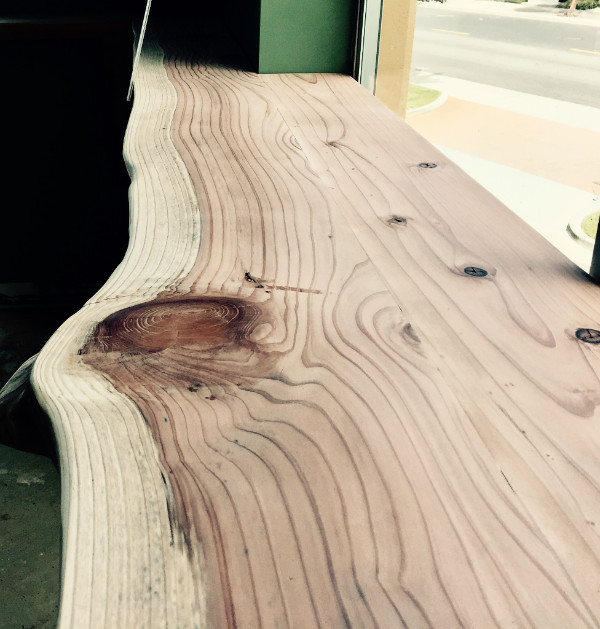
The bar top will be made from long oak planks “with rustic, uneven edges because, you know, that’s less work for us,” they say. And the communal tables will likewise be made of similarly milled and finished cedar and redwood.
All that wood, along with the exposed ductwork, concrete floors and pendant lighting (with LED filament bulbs, no less) will give the main bar area a sort of rustic/industrial vibe. According to Gregory, the taproom “will be the most ‘bar-like’ of the three spaces; dark, high top stand up bars, TVs, loud music, etc.”
and after (almost).
A three-barrel system equals very small batches, and with 15 taps, expect a lot of them, rotating often (their license doesn’t allow for guest handles). They will run the gamut of styles, although Alex and Gregory are self-admitted hopheads so at least three to four will be of the hoppy variety.
“We’ve won a lot of awards for our Saisons and we are really excited and actively working towards starting a cask ale program with beer engines and cellar,” says Gregory. “Eventually we’d like to get in to Brett beers and other sours, but we will have to wait until we obtain another unit so that we can keep the clean beer separate.”
If the bustle of the taproom isn’t your scene and you want something a bit more subdued, head upstairs to what the Zobels call the Framily Room, a brighter, more relaxed space with wood floors, expansive windows, and a mix of lounge and communal seating. You can read, work on your laptop, or simply enjoy the fresh beer you just ordered along with views of Point Richmond from the redwood standing bars along the outer walls.
Back downstairs, through those giant French doors to the right of the bar, is the outdoor beer garden, which “will be filled with communal redwood tables and also features an ordering window so you don’t have to go inside to order,” says Gregory. Since he and Alex are the only two employees for the immediate future, there ain’t no table service. But good craft beer patrons are a patient lot, as it is usually well rewarded.
Soon to support fresh pints. And contemplation.
Sustainability also reigns in the beer garden, as the outer walls are made from repurposed plastic pallets “that we’ve attached plywood over and filled with soil. We are drilling holes into the side of the wall and planting succulents to make a living wall,” says Gregory.
Although they won’t have a kitchen, nearby food choices will be plentiful. Food trucks should be a common sight as a cooperative kitchen is elsewhere in the complex, or you can grab some food to-go at the shopping center across the street.
The generosity and collaborative spirit of the craft beer industry was in full-effect during my visit, as the guys from Benoit Casper stopped by say howdy to check on their progress, crowlers in hand. They, along with Armistice and East Brother Brewing, form the now-trifecta of the Richmond brewing scene. (Perhaps we’ll see a Richmond Ale Trail in the not-too-distant future?)
Armistice Brewing Company is beyond easy to get to, just off the Marina Bay Parkway exit off I-580, so check them out once they open the doors. Assuming all goes smoothly with remaining construction and permits, they hope to have the taps flowing sometime in the early Summer.
I bid my adieus to Alex, Gregory, and the Benoit-Casper crew as the shop talk continued. May it be just one of many, many collegial gatherings to come.