Beerversity: And so it Gose…

Swiped from AVBC's web site. Ask Fal, I'm good for it.
Swiped from AVBC’s web site.

As everywhere in the fickle world of popular taste, beer styles come and go. Today’s IPA is yesterday’s Pale Ale, tomorrow’s Saison might be today’s IPA, etc., etc.

One of the once-lost styles that seems to have made a comeback in the last year or so is Gose.

So what’s a Gose? And how do you even pronounce it?

Second question first. It’s pronounced “goes-uh.” Yeah, I’d feel kinda dumb ordering it, too, if I didn’t know.

Regarding style, from Beer Advocate:

“Gose is an unfiltered wheat beer made with 50-60% malted wheat, which creates a cloudy yellow color and provides a refreshing crispness and twang. A Gose will have a low hop bitterness and a complementary dryness and spice from the use of ground coriander seeds and a sharpness from the addition of salt. Like Berliner Weisse beers, a Gose will sometimes be laced with various flavored and colored syrups. This is to balance out the addition of lactic acid that is added to the boil.”

Or, from the German Beer Institute:

“Gose is an ancient, sour and saline tasting ale, made from more than half malted wheat and the rest malted barley. The brew is fermented with both yeast and lactic bacteria and is spiced with both coriander and hops. It is brewed with slightly salted water. This peculiar beer style is now most closely associated with Leipzig, the capital of the German State of Saxony.”

Or, from the Beer Judge Certification Program guidelines:

“(Gose is a) highly-carbonated, tart and fruity wheat ale with a restrained coriander and salt character and low bitterness. Very refreshing, with bright flavors and high attenuation.”

So class, first question: what one unusual character, trait, or ingredient stands out in all of these descriptions?

That’s right — salt.

Forget the Tecate (for a lot of reasons). Goses (gosii?) have a salt character built into them, whether added directly or brewed using purposefully salty water.

Now, Gose flavor profiles can vary within the style pretty much as any beer in any style, depending on the variables the brewer chooses. Very generally, though, I think of them as maybe a Saison with a salty/sour kick.

But take my description with a, um, grain of salt (sorry). For my vast Gose experience consists of all of one beer — Anderson Valley Brewing’s The Kimmie, The Yink and the Holy Gose Ale.

It may be because I’m just not a sour person (well, actually I am, just not when it comes to beer), but I wasn’t a fan. And please, this is no reflection on AVBC. I’ve interviewed Fal Allen here, he’s a great guy who makes fantastic beers. But based on this one sample, I can’t say I’m a Gose guy. I loved the fruitiness, but it was just too salty for me.

I guess I’ll need to do more research. Tough gig, but it has to be done. I mean, I can’t malign an entire style based on one sample, right? How fair is that?

[BTW, those in the “THERE’S NO SUCH THING AS BEER STYLES” camp, I can hear you screaming from here. I get it. But, in order to make sense of this vast Beerverse, we need to organize things somehow. And if grouping beers with similar characteristics and calling those characteristics “styles” helps us do that, than so be it.]

Up next: you say Gose, I say … Gueze?

Back to Beerversity.

It’s a new year (well, new-ish).  I’m not much on resolutions, which is a cop-out way of admitting I never stick to them.

Still, as I’m sure you’ve noticed, The Beerverse has been dark for a while.  Now, I could hand you a lot of excuses, but they’d be lies.

I’ve just been lame.

For whatever reason, the thought of coming up with ideas for posts, much less actually sitting down at the desk and banging out a few sentences, became too daunting.  After coming home from work each day, it was WAY easier to flop on the couch and potato-out for an hour or five.

So that’s what happened.  And before I knew it, slacking off for a few days turned into months of inactivity.

Then along comes the esteemed beer guru Jay Brooks and Sonoma State.  They’ve partnered to create a Craft Beer Appreciation Certificate course, to be held at Lagunitas‘ facility in Petaluma.

Gotta feed the body before you feed the mind.

I was intrigued and looked into it, but scoffed when I saw the tuition (not cheap).  So I figured that was that.

But, with strong encouragement from my wife, who’s grown tired of seeing her husband slowly turn into an extension of our living room furniture, I swallowed hard and plunked down the cash.

Yes, you’re looking at a newly minted Sonoma State Seawolf.  (Don’t ask me how the basketball teams are doing, I really have no idea.)

So what does this have to do with resolutions?  The biggest reason for going back to school (other than getting off the sofa for a few hours) is inspiration.  I’m hoping being submersed in an academic setting once a week for 12 weeks, meeting like-minded people also eager for knowledge and listening to industry folks, will enable the blog posts to flow like beer from an open tap.

Best. Classroom. Ever.

Speaking of taps, I use the term “academic setting” pretty loosely.  Class will be held in the loft space at Lagunitas, otherwise known as the employee break room.  If you know anything about Lagunitas at all, it shouldn’t surprise you the loft space resembles pretty much any stoner’s basement you’ve ever seen, complete with low ceilings, dank lighting, and ratty couches.

Now add a bar and several taps, and you’ve got our “classroom.”  (Insert “higher” education joke here.)

The course itself will be divided into three areas of emphasis:

  • Beer history and process, including brewing basics and quality control,
  • The business of beer, including equipment, laws and regulations, and distribution,
  • Beer appreciation, everything from styles to sensory analysis, how to conduct tastings, and food pairing.

Mr. Brooks will be laying down all this knowledge with the help of a boatload of guest speakers representing all aspects of the industry, from hop farmers, maltsters and yeast wranglers to brewers and marketers.  Name pretty much any brewery in the Bay Area (and several more elsewhere), and they’ll be represented.

Possible Masters of the Beerverse subjects, perhaps?

Maybe, assuming I get the cahones to ask any of them.  Another resolution to conquer, I suppose.

Beerversity: A Simple Question to Begin…

So, which one's a porter, and which is a stout? Can't tell, can ya?
So, which one’s a porter, and which is a stout? Can’t tell, can ya?

Okay students.  Eyes front.  No talking.  Class is in session.

Welcome to Beerversity.  The only school where I GUARANTEE you’ll love the homework.  And talk about a safety school!  The only way you can get expelled is if you don’t get yourself a DD if you’ve “studied” too long.

Really, I’m here to be a student as much as a teacher.  As much as I loooooove the subject matter, there’s a TON I don’t know.  So, instead of figuring out how basic I should get (“beer is an alcoholic beverage”), the “courses” will be pretty random.

It might be something relevant to a recent post.  Or something I’ve always wondered or been confused about. Or I might try to clear up a common misperception about a style or name.

Still have your attention?  Today I’d like to start with a couple of styles that often get mistaken for each other.

Porters vs. Stouts – What’s the Diff?

How confounding is this question?  Searching “porter vs stout” on Google yields 1,350,000 hits!  So if this question has kept you up at night, you’re definitely not alone.

Sierra Nevada offers one of the simpler explanations that I’ve found:

“By the 1700s, bolder, high-alcohol versions of any style of beer were referred to as ‘stout’ or strong. By then, porter was far and away the most popular beer style in the British Isles, and clever breweries began advertising the stronger versions of their beers as ‘stout porter.’ By the late 1800s, regular porters had fallen out of favor and stout porter, or simply stout, took their place.”

So, a stout is just a stronger porter, right?

Not so fast, my friend (apologies to Lee Corso).

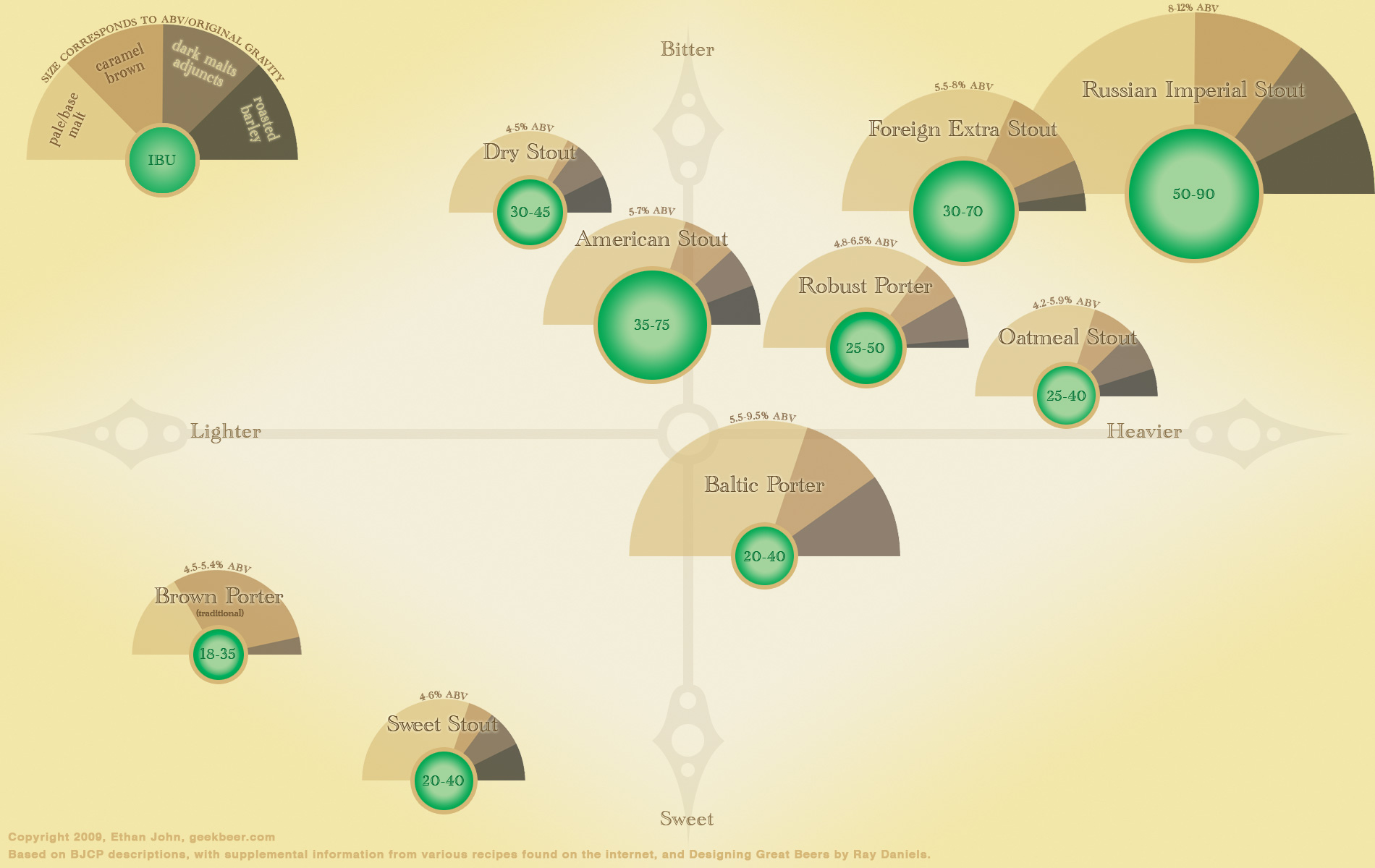
Consulting the Beer Judge Certification Guide for, well, guidance only complicates matters.  They classify three different porter styles (Brown, Robust, and Baltic), and SIX different stouts (Dry, Sweet, Oatmeal, Foreign Extra, American, and Russian Imperial).

I’ve always felt that while they share similar flavor profiles, most notably a dark roastiness, Porters are generally lighter in body and a touch sweeter, while Stouts have a fuller, more weighty mouthfeel, and richer coffee/chocolate flavors.

Does this broad brushstroke hold up to scrutiny?  Like most things in life, it depends on whom you ask.

Of Course They’re Different!  What a Stupid Question!

Jay Brooks, from the Brookston Beer Bulletin, says “Historically, it’s well-settled that they were essentially the same beer, but have diverged in recent decades,” and linked to this poster created by Ethan John of Geek Beer as proof.

“Porters are complex in flavour, range from 4% to 6.5% and are typically black or dark brown; the darkness comes from the use of dark malts unlike stouts which use roasted malted barley. Stouts can be dry or sweet and range from 4% to 8% ABV.” – Campaign for Real Ale (CAMRA)

“Stouts are an extension of the 19th century porter style, originally called “extra stout porter beer.” – Samuel Adams

No Way!  It’s Impossible to Tell Anymore!

“Porters and Stouts share a lot, from history to flavor. Both range from about 4-5 percent ABV (5.5 percent for Porters). Both are moderate in body and carbonation, with mild coffee, chocolate, toffee and roasted malt aromas and flavors.” – Ashley Rousten, CraftBeer.com

From Anchor Brewing:

“There are more stylistic crossovers and intertwined history between modern stouts and porters than among any other two beer styles.

Consider the evolution of brewing along with international variants, throw in the craft brewers with their interpretations, and spice up the whole equation with our vibrant and creative home brewing community and we have style lines that almost defy description.”

For the last word, let’s hear from Michael Jackson (no, not that one, this one), whom many consider the father of the modern craft brew movement, from the same Anchor Brewing post:

“[Porters vs. Stouts are] actually the MOST confused and ill-defined [style differentiation]. He furthermore stated that even the best-researched and well-intended writings on the subject were ‘as unambiguous as a horoscope’.”

So there you have it.  The very first lesson at Beerversity results in a question that can’t be answered.  Off to a great start, aren’t I?  Future classes will be more straightforward, I promise.

Feel free to muddle the debate in the comments.