Just a Stone’s Throw Away…

The Bastard has landed…

I’m typically for the underdog.

I love going to tiny, local places, where the owner/brewers have sunk everything they have into a few tanks and a small bar, and are thrilled to see you and share their creations.

Larger players with a national, even world-wide reach?  Generally, a pass.

But I was excited to visit Stone Brewing’s new Napa brewery and taproom.  I’ve dug pretty much everything they’ve done since my first Arrogant Bastard, and I was eager to try their special Napa-brewed releases.

And the added bonus?  I love historic buildings, and therefore was really interested to see how they rehabbed their new Napa home, which dates back to the late 19th century.

A History of Saving History

Stone Liberty Station is part of the former San Diego Naval Training Station.  Their specific building, the mess hall, was one of a handful of existing buildings when the station was dedicated in 1923.

Liberty Station (as it was later known) was decommissioned in the early ‘90s due to military downsizing.  The site is now a sprawling complex of retail shops, restaurants, hotels, art galleries and studios, fitness centers, and medial practices.

Stone Berlin is the site of a former gasworks complex built in 1901.  The campus includes a 43,000 square-foot main building housing the brewery as well as restaurants, event spaces, and a store.

As for Stone Napa…

Doesn’t look a day over 140.

Felix Borreo, an immigrant from Genoa, Italy, constructed the building in 1877, assembling foot-thick walls of native stone quarried from nearby Soda Canyon.

While Borreo ran his grocery business on the main floor until ultimately selling the building in 1908, he leased the second floor to a succession of tenants, including a carriage shop, feed store, boat house, and shirt factory.

The 20th century saw a revolving roster of businesses, including a cellar for a local winery, a library, a yacht club, a motorcycle repair shop, and, from the ‘30s though the ‘50s, an Oldsmobile dealership.  Its last tenant was a moving and storage company, and the building had been vacant for many years prior to Stone’s arrival.

Give Me a Sign

Because of the parcel’s isolated nature (bordered on two sides by the Napa River), the parking lot is a couple of blocks away, across Soscol Avenue beyond the Wine Train tracks.  There’s only a short driveway next to the building for drop-offs and deliveries.

The “front” door.

And that driveway’s your only real clue how to enter the building.  As is the case with most Stone locations, there’s no signage.  They expect patrons to do their homework and seek them out.  Just a sandwich board in front of two large side doors indicates the entrance.

Once inside, past the host station, the glassed-in brewery is to the right.  Next to that, plenty of swag for purchase.  Straight ahead, large doors lead out to the patio overlooking the Napa River.

To the left is a bar with a wall of taps and two giant video boards above scrolling a dizzying array of selections.  And bonus points for multiple sizes — everything’s offered in 5-, 10-, or 16-ounces, ideal for sampling.

Since I was only there to sample and didn’t plan on eating, I ordered a small pour of the Zubin Pilsner (brewed on-site) and handed over my card.  I figured I could run a tab there and just pop into the restaurant to take a look.

The server came back with my beer, my card, and a receipt for $3.50.  I asked to start a tab, and that’s when they explained I’d need to go the restaurant upstairs to do that.

Would have been nice to know that.

There was a stairway past the bar, but I only saw staff using it, so I thought it was the kitchen entrance.

When I asked if I could bring my beer upstairs, they said certainly, and pointed to that stairway.

The restaurant is beautiful … once I found it.

That was my only real beef with my experience.  The layout is not very intuitive, and first-timers like myself could use a little help with navigation.  A little directional signage would be helpful.

Let There Be … Garage Doors!

Once you get upstairs, the space is, magnificent.  Most of the original windows were either kept or replicated.  The spacious u-shaped bar sits in the middle of the space, surrounded by tables.  Both bars, upstairs and down, were fashioned from timber salvaged during the renovation.

Something old (reclaimed wood bar), something new (giant window).

An alcove at one end features a fireplace (with a giant Stone logo above) with plenty of chairs and couches.  A lively game of charades was taking place while I was there.

The entire scene is capped by a gorgeous arched wooden roof.  Again, old wood timbers are ingeniously used as light-fixtures.  Original stone walls were kept exposed wherever possible.

For most of its early history, the building was at the east end of a row of buildings.  Since other buildings directly abutted it, no windows were possible along its western wall.

Those buildings burned in the mid-‘40s, leaving the Borreo building alone on the parcel.

Stone took advantage of the exposed wall by carving out two massive openings, framed by large roll-up garage doors, one of which was wide open to take advantage of a feature the building never had before — sweeping views of the Napa river and downtown.

In spite of the large doors, this brand-new restaurant has an instant sense of history.  The wood-plank floors, dark wood tables, and comfy Spanish-style chairs add warmth and echo the wood beams in the ceiling.  Rusted copper and metal cage pendant lights lend an industrial edge.

Old room with a new view.

The food menu was still fairly limited as of my visit, although they did offer a salad, a poke bowl, several sandwiches, and a few starters, including a $15 meat-and-cheese board that was more than enough for the couple next to me.  If you can feed two people for $15 in downtown Napa, you’re doing something.

The beer selection, however, was NOT limited.

Freedom of Choice … is What You Want

The menu is helpfully divided into “regions” —  the core-lineup from World Headquarters in Escondido, five Napa-brewed beers, and one each from Liberty Station, Richmond (Virginia), and, yes, Berlin.

Stone made their bones on IPA, and the beer list reflected that.  Fully 13 of the 20 taps were various strengths and styles of lupulin juice, not counting two pale ales and the Arrogant Bastard.

But those whose palates aren’t hop-focused weren’t ignored — two sours, a pilsner, a stout, and a Berliner Weisse (from Berlin, duh) were also on tap.

After sampling, um, several 5-ounce pours (the highlight of which was a DAMNED tasty Skedaddler IPA, a collaboration with Societe Brewing, also of San Diego), I ventured back downstairs for a couple of crowlers.

You know, I can’t decide. Just give me one of everything.

I’m not a whale hunter.  I don’t need to run to a nearby (or not-so nearby) place for whatever-release-day.  There’s so much already there on store shelves and in those tiny local taprooms, there isn’t need.

But I gotta say, having a couple of crowlers of limited-release, locally-produced brews with Stone’s logo on it  is pretty freakin’ cool.

I’ll definitely be back.

Depression Proof

The recent Vintage Beer, Wine & Spirits Labels exhibition at the California Historical Society (CHS) combined three of my biggest passions in life:

  • Printing (I used to be a graphic artist and still work in the printing industry);
  • History (I’m a big historical preservation buff);
  • Beer (duh).

The exhibit, from CHS’s Kemble Collections on Western Printing and Publishing, featured labels printed in the 1930s by the Lehmann Printing and Lithographing Company of San Francisco.

The firm seemed surprisingly depression-proof, as the repeal of Prohibition in 1933 created an instant demand for now-legal alcoholic beverages.  The company, founded with $190 in 1911 by Adolph Lehmann, was by 1935 one of the largest printing facilities in the country, valued at $600,000 and employing 100 people.

Demand was so high, in fact, that Lehmann became a pioneer in developing “stock” or generic labels that could be shipped to a manufacturer to then tailor to their specific products.

The wine industry was also having trouble keeping up, and for decades after repeal produced oceans of sickly-sweet, highly alcoholic wine made of grapes unsuited for the purpose.

The labels, therefore, had to convey the quality that wasn’t in the bottle.  Lehmann’s house style was in full display — exuberant, saturated, flashy colors, bold art-deco-style lettering, and scenes of rolling, vineyard-covered hills.

Early forms of product positioning are also evident.  Depending on the demographic the client was targeting, labels might feature anything from couples in suits and gowns out on the town, to prospectors panning for gold in the mountains.

Wine, spirit, and produce labels made up the majority of the exhibit.  But I, as usual, was here for the beer.

Forgive the quality of these photos.  Ansel Adams with a cellphone I aint.

They may be hard to see here, but numbers are stamped on most of the labels (25, 35, 50, etc.). These indicate, in thousands, the print order for each label.

Depression Proof, indeed.

Mmmmmm, no longer existing beeeeeer…..

Of course, all of the San Francisco area breweries have long since passed, and through acquisitions and mergers (sound familiar?), their histories are murky and difficult to track down (although I tried a while back).  Here’s a brief glimpse.

Founded in 1868 as Bay Brewery, Milwaukee Brewing (as it was known by 1880) moved to 10th Street in 1891.  Closed by Prohibition in 1919, it reopened in 1933 as part of the new San Francisco Brewing Corporation.  The San Francisco Brewing Company (see the Tru-Bru label) was also part of that group.

The 10th Street facility was renamed Burgermester Brewing in 1956 after the Corporation’s then most popular beer, and had a peak capacity of 900,000 barrels.  It was eventually sold to Schlitz, who eventually sold it to Flagstaff, who closed it permanently in 1978.

The site is now a Costco.

United States Brewing began in the 1880’s on Fulton Street, and by 1890 had been consolidated under British ownership into San Francisco Breweries, Ltd.  Only one of the conglomerate’s brands, Fredericksburg Brewing in San Jose, survived Prohibition.

Seattle-based Rainer Brewing opened their San Francisco facility in 1915 to try an end-run around the growing temperance movement.  Washington state had recently voted to become dry, and Rainer’s ownership gambled that California, due its robust wine industry, would remain a hold-out.

They were wrong, of course.  But under new ownership, Rainer relaunched after Prohibition and continued brewing in San Francisco until Hamm’s purchased their facility in 1953.

Lehmann’s also had international clients. Note the early Red Stripe label.

If you missed this wonderful exhibit, I highly recommend its companion books — “Vintage: California Wine Labels of the 1930s,” and “Well Aged: California Whiskey and Spirits Labels of the 1930s.”  Both are filled with vivid examples of Lehmann’s art, and offer great insight into the challenges of both the Depression-era manufacturing and post-Prohibition alcohol industries.

Speaking of books, researching this post reacquainted me with “San Francisco Beer:  A History of Brewing By The Bay” by Bill Yenne.  Filled with historical photos, this is a must have if you’re a beer and history geek like me (although it can already use an addendum since its 2016 printing).

Okay, history lesson over.  Time to check out some contemporary labels I keep on file — in my fridge.

Masters of The Beerverse: Dave McLean

With the possible exception of Anchor Brewing, there probably isn’t a brewery more iconic to San Francisco than Magnolia.

To wit:

Purloined from Magnolia’s website.

Dave McLean, the founder, got indoctrinated into the craft beer scene in the parking lots at Grateful Dead shows in the Boston area the late ’80s/early ‘90s, where many of the Dead’s followers brought brews with them from the West Coast shows.  Once he settled in the City in 1991 (in the Haight, natch), he began home brewing almost immediately.

After finishing the brewing program at UC Davis, he found a space at Haight and Masonic just a few blocks from his home.  The small space had an even smaller basement, in which he managed to cram a seven-barrel brewhouse in 1997.

That tiny brewhouse is still churning out quality brews to this day.

The location already had a colorful history before Dave’s arrival, with one of the former proprietors being the famous Magnolia Thunderpussy.  Given that, you really can’t get more San Francisco than by naming your new brewery Magnolia (Dave continues the tribute with his barleywine — Old Thunderpussy).

Seeking to expand production, Magnolia opened Smokestack, a brewery/BBQ joint/whiskey bar in the Dogpatch district, in 2014.  That name also comes from Dave’s love of history, a nod to the Dead’s remake of Howlin’ Wolf’s song “Smokestack Lightnin'”, as well as to the neighborhood’s industrial past.

(BTW, Magnolia also makes a damned tasty Smokestack Lightning Imperial Stout, which I was fortunate enough to enjoy during the last Beer Week)

Although all his businesses have been profitable (he also owns The Alembic in the Haight), Dave filed for bankruptcy in late 2015, seeking to restructure his debt-load from the expansion.  All businesses have continued operations during the process, which continues.  In fact, during this time Magnolia recently brought their first packaged products into market, Kalifornia Kolsch and Proving Ground IPA, both in cans.

Dave was kind enough to chat with me via email, and talks more about history, Magnolia’s bankruptcy, the Dead’s influence on his record-keeping, the can rollout, and the one collaboration he’d still love to do as Magnolia approaches its 20th Anniversary.


The Beerverse: To get this out of the way, can you comment on how the bankruptcy is proceeding?  Looking good to emerge from it?

Dave McLean: We’re diligently working on our steps forward to emerge and while it has taken longer than I had hoped, I’m pretty happy with how much we’ve been able to accomplish during it and how it hasn’t had any impact on the experience at our brewpubs nor our beer. It was a major milestone to launch our canned beer during this time.

BV: How has the can rollout gone?  Is Blue Bell Bitter still on the horizon?  Are there plans for others?

DM: The cans have been selling so well that it has been hard for us to keep up. It was incredible to see the initial reception in terms of how so many people know the brand and were thrilled to be able to take Magnolia beer home in a convenient format after all these years. We’re just getting to the point where we can spread some around to our other distributors outside of San Francisco and we’re beginning to work on the next releases. Yes, I really want to put Blue Bell in a can.

BV: Putting the bankruptcy aside, how has the Smokestack experience been?  I know you changed chefs and tweaked the menu last summer.  How has that been received?

DM: I feel like both restaurants are operating better than anytime in their past. We saw some opportunities to optimize the service model at Smokestack last year and there are always menu adjustments to be made at both restaurants. Everything seems to be well-received and we have a lot more in the works in terms of some additions to the Smokestack menu.

BV: Some big anniversaries are coming up in the Haight this year — the Summer of Love’s 50th, and Magnolia’s 20th.  Any plans to commemorate the two?  Any special anniversary brews?

DM: Both are big milestones and we’re excited to celebrate them with our community. The Summer of Love is coming up fast and our own anniversary is in the fall. I’m kicking around some ideas for a 20th anniversary beer. More to come on that.

BV: I’m a historical preservation buff (one of my columns is called “Beer Preserves”, featuring breweries in historic buildings).  Can you talk a bit about the history of both locations?

DM: Sure, that’s something that really appeals to me, too. One of the first things I did when I signed the lease for the Haight location was to go to the San Francisco History Room at the public library and dig into what had been there before us.

Our Haight building has a pretty interesting history—built in 1903, it was a grocery store in the early days and then was a pharmacy for many of its years, with that era ending in 1964. It then became the Drugstore Cafe, one of the early hippie businesses in the Haight (they had to change the name to the Drogstore after a run in with the California pharmacy board).

And then a legendary woman named Magnolia Thunderpussy took it over and opened a cafe named after herself. She only ran it for a couple of years but those years stand out in a lot of people’s minds and we still hear anecdotes and stories about her and that era of our building. She moved on and took her name with her (next to the Boarding House on Bush, where she ran the kitchen and put out basically the same menu as she had served at her Haight location).

Our space became the Psalms Cafe, something of a hold-out hippie business after most of them fled and the neighborhood had a long hangover. It was a breakfast spot, Dish, throughout the ’80s until 1996, when I took it over.

While our Dogpatch space [Smokestack] doesn’t have quite as colorful history, it’s special in its own way, as is the history of that neighborhood.

It was the industrial heart of San Francisco for many years, and our building was part of the American Can Company, which started across the street in the early 1900s and expanded by building our building in the 1940s. Incidentally, the American Can Company produced the first beer can, but not in San Francisco (they had several plants around the country).

They shut their San Francisco plant in the 1960s and the buildings sat empty for a few years. The father of the current owner bought them and subdivided them into spaces for artists, artisans and craftspeople, and other creative types who wanted affordable space in a then-desolate part of town.

Now it is at the center of one of the hottest neighborhoods in the city and home to an amazing patchwork quilt of cool, independent San Francisco businesses of all kinds.

BV: I’ve never seen such detailed beer archives on a brewery website.  The way your library can be cross-referenced and sorted is a researcher’s dream.  Why is that so important to you?

DM: I can’t quite explain why, but it is, so we try to record it all. And there’s so much more along those lines that I’d like to add when and if I have time. I’ve always been that way about the Dead, too—identifying with the tapers and collectors who chronicled every version of every song, every setlist, etc. To that end (and sports can be this way, too), the stats and facts can tell stories, reveal patterns and give context to both history and the present. It’s also just fun to look back and be reminded of some of this stuff.

BV: Your list of collaborations is quite impressive.  Are there any bucket-list collaborators you haven’t yet gotten to work with?

DM: Well, what has been most fun about our collaborations has been the organic way in which they have all come about, rather than having a master plan or wishlist. That’s important because to me it helps make the case for one of the things that’s special about the beer world. It’s an amazing community full of friends new and old and the inspiration to collaborate almost always seems to come for me out of a social moment with someone, usually over a beer. That’s what’s fun about it. There’s an element of not trying to hard and letting things unfold in interesting and satisfying ways.

That said, as we approach 20, I think a lot about how much Brian Hunt from Moonlight helped me make Magnolia a reality when most people didn’t think I could squeeze a brewery into the basement at Haight and Masonic. And yet, we’ve never brewed together. I’d like to fix that.

BV: Finally, I gotta ask — hazy IPAs, yes or no?  Is the kerfuffle justified?

DM: I can appreciate the good ones and get the idea but I’m not all that into them.


Thank you, Dave!  I really appreciate you taking the time.

A final note.  Although Dave noted his collaboration brews usually happen organically, I think we as a community need to help him out just this once.  A Magnolia 20th Anniversary collaboration brew with Moonlight needs to happen.  What better way for Dave to celebrate this milestone than with the guy who helped him out so much when he first started?

Mr. Hunt, if you’re reading this, whaddya say?

Friends of Mr. Hunt, if you could pass this note along to him, I’d really appreciate it.  I think we all would enjoy the result.

Session 87: “City Proud of Its Beers”

sessionThe Tale of the Ale’s Reuben Gray, with the following instructions, hosts this month’s Session:

“In Session 87, I want you to give your readers a history lesson about a local brewery. That’s a physical brewery and not brewing company by the way. The brewery doesn’t need to still exist today, perhaps you had a local brewery that closed down before you were even born. Or you could pick one that has been producing beer on the same site for centuries.”

He also further stipulates the brewery be at least 20-years old and within eight hours travel.

This is my first ever Session entry. I apologize if the community frowns upon this, but I’m going to tweak the rules just a bit here. Instead of focusing on a single brewery, I’m highlighting a specific day of an entire community.  In my defense, these breweries, when they existed, would have been about a 30-minute train ride.  (Well, back in the day, probably a bit longer train-ferry-train ride.  You get the idea.)

San Francisco, April 9, 1909

On that date, the San Francisco Call printed a special edition, “600,000 San Francisco,” ostensibly to celebrate the progress the City had made since the great earthquake nearly three years earlier.

600KSF
San Francisco Proud!

The edition highlighted several sectors of city commerce — Financial, Construction, Food Products, and Hotels and Cafes. However, one headline, in the Food Products section, leapt out at me:

“CITY PROUD OF ITS BEERS”

CItyProudI knew I had my Session post.

In April 1909, San Francisco had 23 breweries, worth $30,000,000, employing 800 workers, with a starting salary of $23 per week (approximately $550 in today’s dollars). “Head Maltsters and Brew Masters” averaged about $30 (about $725 today) per week.

In terms of local ingredients, city breweries used 40,000,000 pounds of barley and 600,000 pounds of hops yearly, earning farmers $600,000 and $72,000 per year, respectively. The Call estimated the city spent $2,000,000 yearly for ingredients, and another $1,000,000 for equipment. Based on tax receipts, The Call estimated the city produced nearly 619,000 barrels in 1908, equating to 19,000,000 gallons consumed by local imbibers.

More stats: California was second only to Minnesota in barley production in 1907 (the most recent numbers then available), with nearly 25,500,000 bushels produced. The state had 16,000 acres in hop production.  Although large-scale hop production has all but ceased in California, several breweries (and home brewers as well) have planted hop fields to harvest their own “estate” hops for use in their beers.

And Now, A Word from Our Sponsors…

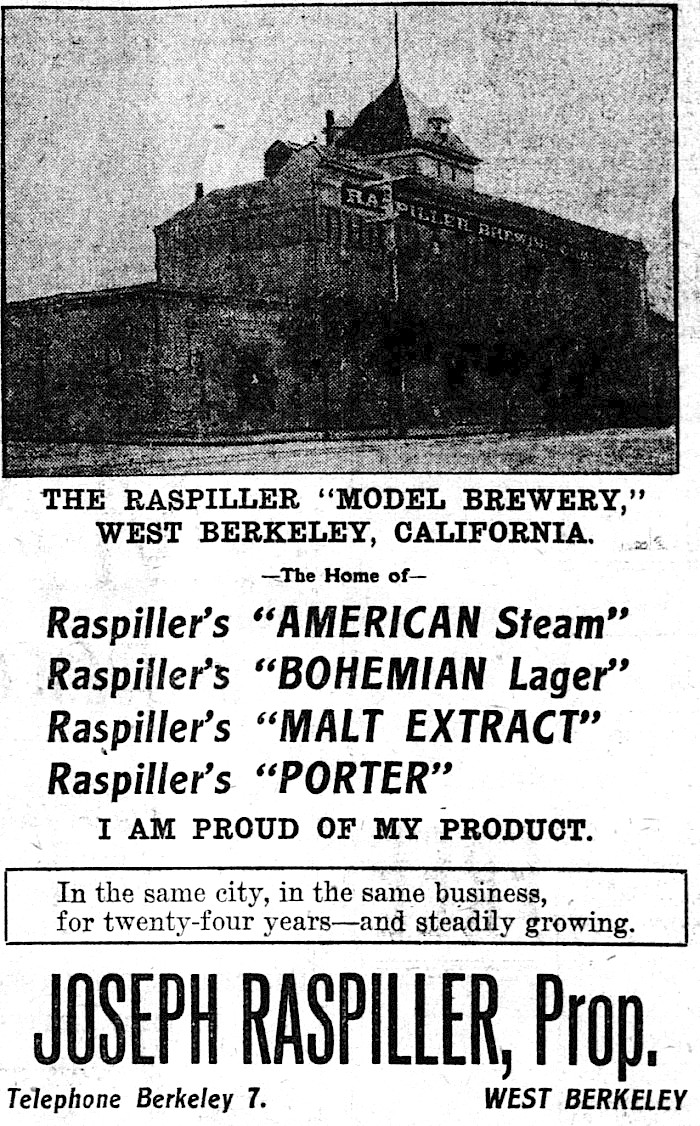
More fascinating than the summation of the San Francisco brewing industry in 1909 is a review of the breweries themselves who ran ads in this special section. It is a wonderful snapshot of the more prominent companies of the time.  Except for Raspiller Brewing, all breweries mentioned were located in San Francisco.

Raspiller Brewing Company

Beer?!  In Berkeley?!?!
Beer?! In Berkeley?!?!

Raspiller, incorporated in 1893, was located across the bay in Berkeley.  Its relationship with the city was rocky at best, as Berkeley, progressive as it may be today, was dry.  As far back as the 1870s, well before Prohibition, the city established a two-mile dry zone around the UC Berkeley campus.  The entire city was dry by 1909, a full 11 years before the 18th Amendment was enacted.  Even after repeal, the original two-mile zone remained into the 1970s.

By 1910 Raspiller had been incorporated into the Golden West Brewing Company, and its plant officially moved to nearby Oakland in 1912.  Golden West continued production in Oakland, resuming after Prohibition, until 1959.

Hagemann Brewing Company

First sugar, then beer, finally ... THE WORLD!!
First sugar, then beer, finally … THE WORLD!!

Hagemann Brewing began its life at the Albany Brewery, founded by sugar magnate Claus Spreckels in 1858.   It was incorporated as Hagemann Brewery in 1888, and continued in various locations in the city until it was closed by Prohibition in 1920.

Union Brewing & Malting Company

"Kids, remember to send one BILLION boxtops to..."
“Kids, remember to send one BILLION boxtops to…”

Union Brewing & Malting was formed in 1902 with the merger of American Railroad Brewery and Union Brewing by Frederick Paul Shuster, son of an Alsatian immigrant.  Union Brewing & Malting continued until 1917, when it merged along with five other breweries to form the California Brewing Association.

This unique ad featured a forerunner to today’s box tops. “Cash checks” were attached to each bottle of their Hopsburger label (“The Golden Beer”). Collectors of enough “cash checks” could turn them in to the brewery for $100!

Unfortunately, the ad neglected to state how many were required. I would guess, however, that in order to receive today’s equivalent of about $2400, it might have been more than a few cases.

Wunder Brewing Company

"If it's a great beer, it's a Wunder."
“If it’s a great beer, it’s a Wunder.”

Originally founded by Jacob Gundlach in 1852, his brewery operated under several iterations, but for most of its existence was known as the Bavarian or Bavaria Brewery.  John C. Wunder purchased the company in 1898 and changed its name to Wunder Brewing.  Wunder itself was sold to Union Malting & Brewing in 1909.

The Wunder name was revived briefly in 2007, when the Wunder Brewing brewpub opened in the Sunset district.  It didn’t last a year, however, and closed in mid-2008.  It’s location seemed cursed, as it hosted a revolving door of brewpubs over the years.  The latest seems to have stuck, as Social Kitchen & Brewery celebrates its 4th Anniversary later this month.

Claus Wreden Brewing Company

wredenKnown alternatively as the Washington Brewery, it began operations in 1859.  According to family lore, Claus Wreden, a grocer, became partner in the brewery in 1864, and was full owner along with his brother Henry, who later sold his interest to his nephew (also Henry). The Claus Wreden Brewery was incorporated in 1899. It operated until 1916, when it was one of the six breweries merged into the California Brewing Association (CBA).

National Brewing Company

Is that an immense plant in your pocket, or...
Is that an immense plant in your pocket, or…

The National Brewing Company operated from 1861 through 1916.  It was also one of the brands incorporated into the CBA, and was one of only two facilities that remained in operation after the merger. During Prohibition, the former National plant operated as the Cereal Products Refining Corporation, the name of the reorganized California Brewing Association.  It produced several malt syrups, vinegar, yeast, and ice cream.

The plant resumed brewing beer upon repeal in 1933, with National being one of the brands produced.  The label was soon dropped as the reconstituted CBA focused all its marketing efforts on its highest selling brand, Acme.

This ad includes one of the unintentionally funny subheads I’ve ever read:  “Sold Every Day of the Year — Somebody Must LIKE It.”   I wonder if they ever found out who that was…

Enterprise Brewing Company

Maybe someone in Yosemite knows something about this place.

Enterprise Brewing was founded in 1873 in what is today the Mission District, and operated until Prohibition closed it in 1920.  To be honest, I found almost nothing about the brewery in my research.  The wonderful beer history site Bygone Beer featured a nice reproduction of this same ad.  Bygone Beer is an amazing site, be sure to spend some time there.

Oh, and at least a portion of the old brewery survives today as an artist’s loft.

 John Weiland Brwery

Beer .. is there anything it can't do?
Beer .. is there anything it can’t do?

John Weiland purchased the existing Philadelphia Brewery and renamed it in 1856.  For more on its history, see my recent post.

Gotta hand it to these guys, they’ve covered just about everything.  Beer is better than cider, milk, coffee, and bread.  And who can argue, really?


The Call majestically concluded its review of the 1909 San Francisco brewing scene this way:

“San Francisco is proud of its breweries and proud of the men who have been engaged in the brewing business. They have always been energetic, progressive, charitable and good masters; they have taken a large share in the civic activities of the municipality; and they have helped, by their excellent products, to spread the fame of this city all over the world as a place where beers are made that ‘go straight to the spot.’”

Their tradition continues, even if their breweries didn’t.

All newspaper images are courtesy of the California Digital Newspaper Collection, Center for Bibliographic Studies and Research, University of California, Riverside, <http://cdnc.ucr.edu>.

Beer Preserves: Bay Area History, and I’m a Thief

I’m a plagiarist.

Okay, not in the literal stealing-multiple-paragraphs-and-presenting-them-as-my-own sense.  But I am definitely stealing someone else’s idea.  And running with it.

More on that in a bit.  First, if you’re as devoted to beer and history (and therefore the history of beer) as I am, there are two sites you need to check out.  Immediately.

Brian Stechschulte, Executive Director of the San Francisco Brewers Guild (and SF Beer Week organizer), has recently launched Bygone Beer.  This beautifully designed site is required reading for anyone into breweriana, and the interactive map of historic San Francisco brewery locations alone is worth visiting.  Go there.

Jen Meuhlblauer’s East Bay Beer has also been investigating historical brewery sites in, well, the East Bay (duh).  Her “Imagine a brewery here” series has focused on several Oakland locations.  She’s a tremendous writer anyway, and this series (and accompanying photos) is a must read for historians.

But back to my larceny.

Both of these sites recently featured newspaper clippings from around the turn-of-the-20th-century (ish).  After reading them, an idea struck me.  Which really hurt, as it happens so infrequently I wasn’t used to it.

I also write posts for the Hercules Historical Society (of which I’m a member, check us out and buy our book).  I’ve written several accounts of our town’s early days based on old newspaper articles.  It suddenly occurred to me, why don’t I do the same thing here, only for beer??

So, TA-DAAAAA, here’s the first one.

From the San Francisco Call, August 11, 1910:

WielandAdSFCall8-11-10
Courtesy California Digital Newspaper Collection, Center for Bibliographic Studies and Research, University of California, Riverside, http://cdnc.ucr.edu

John Wieland Brewery was located in what is now San Francisco’s SOMA district.  Mr. Wieland, a gold miner, baker, and beer baron, purchased and renamed the Philadelphia Brewery in 1856.  Upon his death in 1885, the brewery was sold by his heirs to San Francisco Breweries LTD, but continued to operate under the family name.

(BTW, here’s a cool then-and-now site photo.  Just move the slider horizontally to see two photos right on top of each other.  Spiffy.)

The brewery was leveled by the 1906 earthquake, then rebuilt on the same site.  Prohibition did what the quake couldn’t and closed the facility in 1920.  After repeal, it moved to San Jose, where it operated until 1956.

So, with apologies and thanks to Brian and Jen (as well as Jay Brooks, who’s been running his Beer in Ads series for years), look for more of these in future posts.  I love beer, and history, and worked for many years at a newspaper.  I’m currently kicking myself for not thinking of this sooner.


Beer Preserves: This Place Will Give You the Vapors

Superior Bathhouse Brewery & Distillery, Hot Springs, Arkansas

How about a beer and a bath?  Or a beer FROM a bath?  I'll explain. Courtesy Superior Bathhouse
How about a beer and a bath? Or a beer FROM a bath? I’ll explain.
Photo courtesy Superior Bathhouse

The mineral-rich, naturally heated waters in Hot Springs, Arkansas reportedly provide a great many benefits — relaxation, detoxification, enhanced immune and digestive systems, healthier skin…

and beer?

Rose Schweikhart Cranson thinks so.  She and her husband Todd have opened Superior Bathhouse Brewery & Distillery in Downtown’s Bathhouse Row, continuing the district’s recent revitalization.

During its heyday at around the turn of the 20th century, driven by the belief of the healing powers of the springs (and the desire to cash in on those powers), Bathhouse Row boasted at least eight bathhouses.  However, once modern medicine began discovering more convenient remedies to cure most ills, the district declined.  By the 1980s, many were long shuttered and in disrepair.

While only two bathhouses remain in business (Buckstaff Baths and Quapaw Baths & Spa), many others have been rehabbed into restaurants, a museum, visitor center, and a performing arts center.

And now, a brewery.

According to the National Park Service, the Superior Bathhouse opened in 1916, and was the smallest on Bathhouse Row.  It was also the most budget-friendly, catering to those who wanted (or could only afford) the most basic hydrotherapy and spa services.  It closed in 1983.

Of course, building a business from scratch presents a myriad of challenges.  Doing so in an historic building (in a National Park, no less) only multiplies them.  The tasting bar, located in the bathhouse’s former lobby, features a 97-year-old marble counter that, due to regulations, cannot be altered in any way.

So how do you install the taps?  The Cransons enlisted a local welder to fashion a unique draft tower, mounted from the ceiling.  The draft system makes a dramatic statement in the tasting area, and can even be seen from the street.

Behind the bar is a wall of safe-deposit-like lock-boxes where patrons’ valuables were kept while they bathed.  These will house mugs for the new patrons who enlist in Superior’s mug club.

Meanwhile, the brewery, built in the former males-only bathing room with direct access to the springs, isn’t yet online (they hope to be brewing by the end of the year).  Once it is, it will be truly unique, taking full advantage of its location to become not just the only brewery in the National Park system, but the world’s only brewery to use naturally heated spring water in the brewing process.

“It’s normally not potable—just think about Yellowstone—but ours is fantastic,” said Cranson in a recent interview with the National Trust for Historic Preservation.  The water’s mineral content will provide a unique twist to each beer’s flavor profile, and they’ll save time and money by using only minimal energy to heat it.

Once available, the Superior’s house beers will be sold under the brand name Vapor Valley.  Naturally.

In the meantime, for those wanting to retoxify after a thorough cleansing, patrons can enjoy regional brews from several nearby states.

Thinking of stopping by?  The Hot Springs Convention & Visitors Bureau is packed with all the info you need to plan a trip.

Know of an historic brewery, or a brewery in an historic place?  Drop me a line at thebeerverse[at]gmail[dot]com and I’ll check it out!